Showing posts with label Lament Configuration. Show all posts

Sunday, September 15, 2024

11. Hellraiser (2022).

The Hell Priest (Jamie Clayton), aka Pinhead, torments a victim.
The Hell Priest (Jamie Clayton) torments a victim.

Release Date: Sept. 28, 2022. Running Time: 121 minutes. Screenplay by: Ben Collins, Luke Piotrowski. Story by: David S. Goyer, Ben Collins, Luke Piotrowski. Directed by: David Bruckner. Produced by: David S. Goyer, Keith Levine, Clive Barker, Marc Toberoff.


THE PLOT:

Riley (Odessa A'zion) is a recovering alcoholic and drug addict. She's staying with her brother, Matt (Brandon Flynn), his boyfriend, Colin (Adam Faison), and their roommate, Nora (Aoife Hinds) while working a dead-end job and dreaming of better things. In short, the perfect setup for a sitcom.

At least, until Trevor (Drew Starkey), whom she met in a twelve-step program, offers an opportunity for some easy money by breaking into an abandoned warehouse. They're hoping for gold bars or bonds. What they find is a puzzle box, which captures Riley's attention enough for her to bring it home with her.

After an argument with Matt drives her out of the apartment, Riley relapses with some pills, opens the box, and sees a vision of demons. Then her brother comes to rescue her. He cuts his hand on a secret blade in the puzzle box, only to disappear immediately after... and Riley sees the box change shape with his disappearance.

Riley connects the box to Roland Voight (Goran Višnjić), a wealthy businessman who disappeared six years earlier. She goes to his now derelict mansion and finds Voight's journal, which describes the box and its six configurations, which move from the initial cube-like Lament Configuration all the way to its final form, the Leviathan Configuration, which grants the user an audience with "God."

Riley believes that if she can solve the puzzle, she can get her brother back. But each of the box's configurations requires a new blood sacrifice. She still has three steps left to get her wish - but the price may be too high!
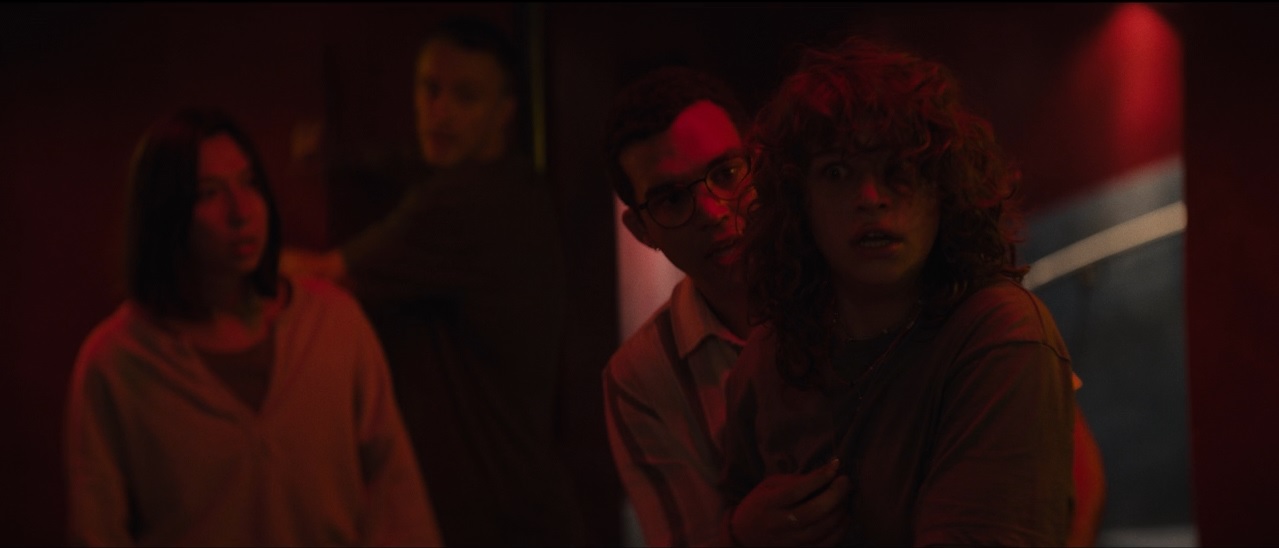
Riley (Odessa A'zion) and her friends are hunted by the Cenobites.

CHARACTERS:

Riley: The Riley we first meet is selfish, defensive, and more than a little belligerent - a fair characterization for an addict but not necessarily one that encourages viewers to want to spend time with her. We see enough of her daily life to know that she relies heavily on her brother. When the Cenobites begin stalking her and her friends, her first impulse is to say that Matt would know what to do (unlikely). She gradually emerges as a leader in her own right, keeping the group moving toward the relative safety of Voight's house and hatching a plan to try to save them, even as she still hopes to somehow get her brother back.

Colin: The boyfriend of Riley's brother, who is emotionally supportive to both of them. When Matt gets angry and kicks Riley out, Colin urges her to stay, insisting that this is just a bad night and that things will be better in the morning. Matt's disappearance has to be affecting him too, but he only truly lets that show in the immediate aftermath before setting his feelings aside to try to help Riley. True, his initial worries are more about her relapsing than about running into literal creatures from hell - but even when the demons appear, he manages to keep it together better than almost anyone would.

Trevor: Riley's new boyfriend, who kicks off this situation when he leads her to the puzzle box. After Matt disappears, he tries to take the box away from Riley, which she sees as a betrayal. When they come to find her in the second half, he and Colin fall to arguing almost immediately, leaving it to Riley to keep them both focused on the immediate problem.

Nora: Matt and Colin's roommate, Nora seems like an entirely decent person. She's not above teasing her friends, casually and visibly eavesdropping when Matt and Riley argue, but she's also ready to drop everything to help when needed. At Voight's house, when Trevor starts to pour a drink, she lightly reproves him for it: "We don't drink when Riley's around."

Matt: Riley's brother, whose disappearance motivates her actions for the rest of the movie. He behaves almost like her father, trying to set rules and boundaries that she inevitably kicks against. He kicks her out, only for the initial anger to fade, at which point his guilt leads him out to search for her. When he finds her in a stupor, he focuses on getting help for her, even when he cuts his hand - quite badly - on the puzzle box.

Voight: Goran Višnjić, as the occult-obsessed billionaire, grants considerable screen presence. His Voight conveys complete self-interest. "I get what I want!" he declares defiantly, treating dealings with demons as if he's in the midst of a real estate transaction. He cares nothing about others, and the movie opens with him tricking a young man (Kit Clarke) into solving the puzzle box so that he can sacrifice him for a wish. You don't have to have seen any of the other Hellraiser films to guess that Voight gets his wish, but not in the way that he'd have preferred.

Pinhead urges Riley to continue solving the puzzle.
"We want you to proceed." Pinhead urges Riley to continue solving the puzzle.

JAMIE CLAYTON AS PINHEAD:

"What is it you pray for? ...What would it feel like? A joyful note, without change, without end? Heaven? There's no music in that... There is so much more the body can be made to feel - and you'll feel it all before we're through."

This film bills Pinhead simply as "The Priest," because co-producer Clive Baker, author of the original novella and writer/director of the original film, hated the "Pinhead" nickname. Nice try, Mr. Barker, but I'm pretty sure everyone will continue referring to the character as Pinhead.

The book describes the Hell Priest as having no gender and a feminine voice, something Jamie Clayton conveys. The heavy costume severely restricted Clayton's movements. This has the same effect as it did on Doug Bradley's initial performance, with the stillness and rigid posture granting a formality to every step and gesture. Also like Bradley in the first film (far less so in the sequels), Pinhead doesn't threaten; she teases and promises, and you are best advised to avoid receiving any of her "gifts."

Though Clayton is more book accurate, I'm not remotely saying that she's better than Doug Bradley. Bradley's Pinhead is a horror icon. At his best, he was mesmerizing, alternating between anger and amusement, between impatience and weariness, often with just the tiniest shift of tone. Still, Clayton's a reasonably close second, and I would not in any way object to more films featuring this version of the character.

Riley stares at the puzzle box's newest configuration.

THOUGHTS:

David Bruckner's 2022 Hellraiser reboot is the first entry since Bloodline to have official involvement from Clive Barker. It's probably no coincidence that it's also the best film in the series since the first two, and probably the best since the 1987 original. 

That said, and as fond as I am of the early Hellraiser movies... This doesn't exactly clear a formidably high bar. The first movie remains excellent even decades later. Other entries are "flawed but ambitious," while the rest range from mediocre to downright awful.


WHAT DOESN'T WORK:

Hellraiser (2022) is a reboot, so it's fair enough that it changes some of the lore. A few of those changes are ones that I like... but I don't like Cenobites claiming innocent victims. "It is not hands that call us" is a lot more interesting - though, in fairness, after the first two films, the original series deviated from that principle more often than it stuck to it.

The movie's biggest problem is its length. The story here would make for a really good 100-minute horror flick. At 121 minutes, it feels overstretched. The plot doesn't properly kick into gear until Riley reaches Voight's estate, and that doesn't happen until the 50-minute mark. It gets rather good at that point and stays good through the end - but I did a fair amount of seat-shifting before then, with the first half hour coming distressingly close to boring me.

This would be fine if that time had been used to build memorable characters. Except for Riley, the members of the core group are as two-dimensional as the supporting casts of the direct-to-video entries. They never move beyond their initial descriptors: Brother, Boyfriend, Brother's Boyfriend, Roommate.

There's a memorable kill scene at the halfway mark in which one of the group is left to Pinhead's nonexistent mercy. Everything about the scene works: the victim's terror, Pinhead's speech, the ghastly cleverness to Pinhead's act and how that act ties in with her words. It's a great horror movie bit, disturbing and gripping all at the same moment - and if I had actually cared about the victim, it would have been truly unforgettable.

Voight's estate is a puzzle box in its own right.

WHAT WORKS, AND OFTEN QUITE WELL:

This film makes good use of the idea of the puzzle, something that was entirely lost in the earlier sequels. Each new configuration requires effort, and the progression from one shape to the next provides a goal beyond merely opening it. The individual bits of the box rotate, with shifting patterns according to those manipulations. Voight's mansion is a puzzle box in its own right, surrounded by metal gates and doors that open and close with the flip of switches. The landscape shifts in ways that resemble the shifts of the box, an ominous visual to herald the demons' arrival.

Riley is an addict, and her use of the box echoes facets of addiction. In narrative terms, the puzzle box is Riley's only hope of getting her brother back. It also works as a stand-in for her addiction. As Voight demonstrated, the box's promise is much like a drug's promise of satisfaction - a lie, a trick. There's no way to "win," and the Cenobites' gifts will not please those who receive them. But when the others try to get her to see this, she lashes out, even snapping at Trevor for betraying her when he tries to take it from her. Whether Matt even can get his resurrection or not is questionable. What's not in question is that Riley's fixation threatens to destroy not only her, but also the people who came to help her.

Though the first half is too slow, patient viewers will be rewarded with a strong second half. The barrier surrounding Voight's house allows the characters to get to something approximating safety, which allows them to think, react, and plan. But they are also under siege from that moment, with the Cenobites waiting outside: patient and unmoving as they await the blood that is their due. It's a situation well-suited to building tension.

I also quite like the ending. I won't discuss it, because I don't want to risk spoiling it for anyone who hasn't seen the movie. But it's an excellent finale in terms of both story and theme, and I found it vastly more satisfying than a "Final Girl" manipulating the box and shouting, "Go to hell!" at Pinhead.
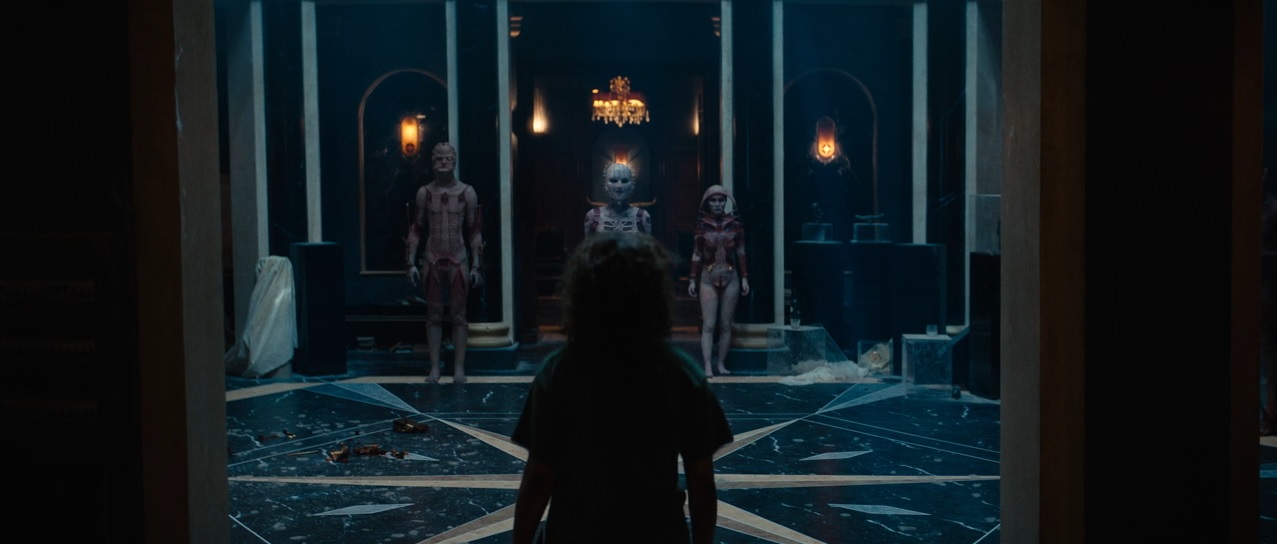
Riley confronts the Cenobites.

OVERALL:

Hellraiser (2022) is a good movie on its own terms, and it's exactly the resurrection that this series needed after years in the low budget direct-to-video graveyard. It has its issues, notably a painfully slow start and a bland supporting cast. It's clear watching it, however, that thought and effort went into its making.

There's room for improvement. But for the first time in a long time, I find myself hoping that there will be another Hellraiser. If another movie refined and built on the elements that worked, and rejected the ones that didn't, I think the result might be something special.


Overall Rating: 7/10.

Previous Movie: Hellraiser - Judgment

Review Index

To receive new review updates, follow me:

On Twitter:

On Threads:

Friday, April 26, 2024

9. Hellraiser: Revelations.

Emma Craven (Tracey Fairaway) finds a puzzle box among her missing brother's possessions. Tedium ensues.
Emma Craven (Tracey Fairaway) finds a puzzle box
among her missing brother's possessions. Tedium ensues.

Release Date: Mar. 18, 2011. Running Time: 75 minutes. Screenplay by: Gary J. Tunnicliffe. Directed by: Victor Garcia. Produced by: Aaron Ockman, Joel Soisson.


THE PLOT:

Nico (Jay Gillespie) and Steven (Nick Eversman) take an impromptu trip to Mexico, with Nico enthusing that this trip will allow his friend to finally lose his virginity. Their little vacation quickly goes awry. A series of events that seem like the plot of a rejected Hangover knockoff culminate in Nico opening the Lament Configuration and summoning the Cenobites, while Steven looks on in horror.

A year later, their families gather together to eat and drink and... not much else, really. Emma (Tracey Fairaway), Steven's sister and Nico's girlfriend, is upset at everyone's refusal to talk about the missing boys. She sneaks into Steven's room and finds among his things a tape the boys had made of their misadventures and the puzzle box. She begins playing with the box, partially opening it.

She's interrupted by an unexpected visitor: Steven! He has returned, weak and disoriented, raving about he escaped from "them" and how Nico didn't want to come back. His father wants to take him to the hospital. But when he checks the driveway, both cars are gone, and the phone is out of service.

They decide to wait for morning, putting Steven to bed to recover. But the long night has only just begun, and not everyone in the house will survive to see the morning...

Ross (Steven Brand) tries to get answers from a disoriented Steven (Nick Eversman).
Ross (Steven Brand) tries to get answers
from a disoriented Steven (Nick Eversman).

CHARACTERS:

Ross: Steven and Emma's father, a psychologist of some sort, though that never plays into the story. He's presented as someone upright and responsible, and he takes charge once the characters find themselves cut off from the world. He's not a particularly interesting character, with even the secret he's hiding being pretty mundane. Still, actor Steven Brand at least has a hint of screen presence, which is more than can be said for the rest of the cast.

Steven/Nico: Of the two missing friends, Nick Eversman's Steven is very much the "beta," following Nico's lead in all things, even when he knows that he shouldn't. Jay Gillespie's Nico swaggers around like someone who believes himself the king of all he surveys. Flashbacks show that Nico not only led both of them into trouble, but that he was a monster long before the Cenobites ever showed up.

Emma: Steven's sister and Nico's girlfriend, which makes her the most direct connection between the two families. And that, and being upset about the boys' disappearance, is about it for her character. We're told that she harbors a "darkness," but we never really see it. Well, unless you count her flirting with Nico's father (Sebastien Roberts), another element that never goes anywhere. Actress Tracey Fairaway is pretty... which is about all I can say, as there is little opportunity for her to act either well or badly.

This movie's lead Cenobite. I refuse to call him Pinhead.
This movie's lead Cenobite. I refuse to call him "Pinhead."

STEPHAN SMITH COLLINS AND FRED TATASCIORE AS NEEDLE-FACE:

Doug Bradley turned down Revelations, citing a script that he felt was "unfinished" and a payment offer that was inadequate. As a result, this movie's version of the lead Cenobite is portrayed by two actors: the physical form of Stephan Smith Collins and the voice of Fred Tatasciore.

Tatasciore is generally a very good voice actor, and I specifically praised his performance as the villainous Saren in my review of Bioware's Mass Effect. But here, he just sneers his lines in a generic villain voice, while Stephan Smith Collins unsuccessfully attempts to project a menacing presence. Google "Pinhead cosplay," and you'll find far more convincing and threatening Pinheads than this.

I'll be fair: It's not like the filmmakers could help Doug Bradley turning them down. They could, however, have given his replacement a chance by keeping his characterization consistent with other entries. Nope. At one point, he tells the boorish Nico that he has "a darkness that rivals my own." Pinhead's human form was in the trenches at World War I; he'd have found the likes of Nico tediously ordinary long before he came into possession of the puzzle box. This guy doesn't even deserve to be called Pinhead, which is why I've decided to refer to him only as "Needle-Face."

Pinhead was a "Hell Priest" who believed in order and abided by a certain set of rules. By contrast, Needle-Face is a generic slasher. Even when Bloodline threatened to reduce Pinhead to that state, he retained a certain reflective eloquence. Needle-Face just growls, "Fool," at his human victims, like he's been possessed by the spirit of Mr. T. One scene sees him straight-up murdering a victim who neither opened the box nor desired anything. Why? Because that person directly provided him with relevant information. He claims another victim, one who also had nothing to do with opening the box. This is done to punish another character, one who - you guessed it - also had nothing to do with opening the box.

Back in Hellbound, when the evil Dr. Channard made Tiffany open the Lament Configuration, the real Pinhead refused to claim her. "It is not hands that call us. It is desire!" Based on this movie, Needle-Face would not only have pounced on Tiffany - He'd have also told his minions to massacre everyone in a 5-mile radius.

But then, at his best, Pinhead was an interesting character. Needle-Face is just a bad costume.

The families on the anniversary of their sons' disappearance. In retrospect, I think they were celebrating.
The families on the anniversary of their sons' disappearance.
In retrospect, I think they were celebrating.

THOUGHTS:

"If they claim it's from the mind of Clive Barker, it's a lie. It's not even from my butt-hole."
-Hellraiser creator Clive Barker's response to the release of Hellraiser: Revelations.

Doug Bradley would later refer to Hellraiser: Revelations as an "ashcan movie," and that's fairly accurate. This was not made to actually do anything with the Hellraiser franchise. Revelations was cranked out, script to (sole) theater screening, in a matter of weeks so that Dimension films could retain the franchise rights. Wikipedia lists its estimated budget at $300,000. If you told me the actual amount was a tenth of that, I would absolutely believe you.

You can make a good movie with very little money. Genuinely fine films have been made on lower budgets than Hellraiser: Revelations. But if you have no money, then you need time to get the script right. On the reverse end, studios can still sometimes make watchable movies with no time by throwing money at them.

Take away both resources, and... well... (shrugs)

From its opening moments, Revelations resembles nothing so much as a bad fan film. It's cheap, with most of the story unfolding in just a couple of sets. The story has one halfway clever element... one that's a direct lift from the original 1987 Hellraiser. And yes, the presence of Needle-Face destroys any semblance of a professional product every time he lurches onto the screen.

Nico bullies Steven. With competent writing, their toxic friendship might have been interesting.
Nico bullies Steven. With competent writing, their
toxic friendship might have been interesting.

GLIMMERS OF UNREALIZED POTENTIAL:

There are ideas that could have worked, had the script gone through multiple drafts and had it been given to a director not best known for such works as Return to House on Haunted Hill. The story moves back and forth between the present-day timeline and flashbacks of Nico and Steven's ill-fated Mexico trip. As presented, this is annoying, mainly because Nico and Steven are instantly unbearable. But had the script pared back on their jerkiness and made them seem like average kids, only gradually revealing that Nico is a sociopath who has made Steven emotionally dependent on him, it might have been interesting.

The present-day plotline could also have worked. The idea of structuring a low budget Hellraiser as essentially a stage play, with character relationships and secrets gradually unveiled, has potential... but only if the characters have layers worth peeling back. Emma flirts with Nico's father, who is entirely responsive to that. Instead of following up on this, it ends up being a single interaction that no one ever even comments on. A secret is revealed at the very end. Fine, except there is absolutely nothing that builds to it and practically nothing proceeds from it, making it just a bit of soap opera theatrics. I've already mentioned that Emma is two-dimensional eye candy. Well, she's an Ibsen heroine compared to the two wives, who say little and do nothing.

So yes, there were a couple of ideas with a hint of potential. Hellraiser: Funny Games? I wouldn't mind seeing a decent take on that. But as it stands, most of the film just has us waiting around for the Cenobites to show up and put these characters out of our misery.


OVERALL:

Gore effects are decent, which I think shows where the production's priorities lay. That aside, this movie fully lives down to its terrible reputation. It isn't even comically bad, save for a few chuckles and facepalms courtesy of Needle-Face. The bulk of this can be summed up with the most damning descriptor I can think of for any movie:

It's boring.


Overall Rating: 1/10. Can we have Rick Bota back?

Previous Movie: Hellraiser - Hellworld
Next Movie: Hellraiser - Judgment

Review Index

To receive new review updates, follow me:

On Twitter:

On Threads:

Tuesday, October 31, 2023

4. Hellraiser: Bloodline

18th century toymaker Philip LeMarchand (Bruce Ramsay) completes his masterpiece, The Lament Configuration. He'll soon wish he hadn't.
18th century toymaker Philip LeMarchand (Bruce Ramsay)
completes his masterpiece. He'll soon wish he hadn't.

Release Date: Mar. 8, 1996. Running Time: 85 minutes. Screenplay by: Peter Atkins. Directed by: Alan Smithee (Kevin Yagher; Joe Chappelle - reshoots; Rand Ravich - reshoots). Produced by: Nancy Rae Stone.


THE PLOT:

In 1796, toymaker Philip LeMarchand (Bruce Ramsay) designs the Lament Configuration. It's a special commission for Duc de L'Isle (Mickey Cottrell), an aristocrat deeply into the Occult. LeMarchand delivers the box, only to watch as his creation is used to summon the demon Angelique (Valentina Vargas). Horrified, Philip tries to steal the box back - only to become a victim of Angelique's nonexistent mercies.

In present day New York, his descendant, John Merchant, is a celebrated architect. His newest creation is a building that uses designs from his dreams - the same designs utilized in the puzzle box. Angelique is drawn to both him and his building. She retrieves the puzzle box that had been encased in cement, and she uses it to summon Pinhead. Both demons recognize in Merchant's work the potential for a permanent gateway between their dimension and reality.

Finally, in 2127, it falls to Dr. Paul Merchant, last of the LeMarchand bloodline, to a put an end to all this. Merchant has designed the space station Minos. The station is actually a trap. Its purpose? To lure Pinhead and Angelique out, in order to destroy them once and for all!

Angelique (Valentina Vargas) attempts to seduce John Merchant.

CHARACTERS:

The LeMarchands: The lead role in Bloodline is fairly demanding as low-budget horror roles go. We see three generations of LeMarchands/Merchants, requiring the actor to create three distinct people while at the same time giving a sense of a single, unified presence. Bruce Ramsay is not a bad actor, as a glance at his filmography should show, but he is not up to this challenge. There's little in the performance that distinguishes the three generations, and Ramsay's performance often verges on the robotic. The result is a void where the center of the picture should be.

Angelique: Valentina Vargas's voice was dubbed, but that doesn't diminish her physical performance. The ill-fated peasant girl of her first scene is completely different in posture, expression, and demeanor from the demon princess of the rest of the film. Angelique summons Pinhead to further hell's interests, only to find her position weakened by his presence. Deleted scenes make clear that she even keeps secrets from him, hoping to regain dominance by using John Merchant - though this thread is so pared back in the theatrical release that the few remaining John/Angelique moments don't really seem to come from anywhere or lead to anything.

Bobbi Merchant: Horror movie veteran Kim Myers plays John's wife. Bobbi is concerned about her husband's nightmares, urging him to see someone. The middle portion of the present-day strand relegates her mainly to just "worried wife and mother." Still, the last bit of her story allows her to do some demon fighting, banishing monsters with the puzzle box as she tries to protect her family.

Duc De L'Isle: The depraved aristocrat who commissions the Lament Configuration and imbues it with its demonic purpose. In just three scenes, actor Mickey Cottrell makes him the movie's most memorable figure. He's creepier than any demon as he grins and congratulates LeMarchand on his punctuality in making his delivery. "As precise as your pieces, as timely as your toys." Every aspect of him screams of depravity, from his heavily caked-on makeup to his exaggerated facial expressions to the almost sing-song intonations of his voice.

Naturally, this film relegates him to little more than a cameo... a consequence of production interference, which turned out to be this movie's biggest problem.

Pinhead has a bad day. And, despite Doug Bradley's best efforts, a bad film as well.
Pinhead has a bad day. And, despite Doug
Bradley's best efforts, a bad film as well.

PINHEAD: OVERUSED, AND USED BADLY:

Doug Bradley is as good as ever, but at this point the pincushioned one is getting a bit... dare I say, boring? A large part of the problem is the last two movies' shift in the character's portrayal.

In the first two films, he was a powerful presence who was little seen. He was in only eight minutes of the original Hellraiser, and he wasn't in much more of Hellbound. He also had his own set of ethics, as warped as they were: He abided by a strict set of rules, refusing to punish the innocent. "It is not hands that call us. It is desire!" He might have been the figure of horror... but it was the humans who were the true monsters.

Well, forget about that. As in the third film, Pinhead is reduced to a bloodthirsty slasher. The closest this film comes to acknowledging his prior characterization is when he tells Angelique that hell is more ordered under him. Despite that claim, there's no indication that he's following any rules here. Most of his victims haven't opened the puzzle box, nor are they guilty of any dark deeds or desires that demand demonic attention. Bloodline's Pinhead is simply a sadist who enjoys torturing people.

He still gets a few good lines. I particularly enjoyed his speech near the end, as he looks out at the Earth and ruminates: "There are more humans alive at this moment than in all (Earth)'s pitiful history." But such moments are like dying echoes of the early titles' remote-but-fascinating figure. This Pinhead is a completely different character: Freddy Krueger, with less sense of humor but a lot more eloquence.

Duc D'Lisle (Mickey Cottrell) and his assistant, Jacques (Adam Scott). The Duc's role was meant to be much larger.
Duc D'Lisle (Mickey Cottrell) and his assistant, Jacques (Adam
Scott). The Duc's role was meant to be much larger.

THE BOWDLERIZATION OF HELLRAISER BLOODLINE:

Peter Atkins' original script has since been published, revealing the movie the filmmakers actually wanted to bring to life. The present-day segment is largely recognizable, but the historical segment was gutted. The 18th century segment was much longer in general than in the finished film, with a full subplot in which Angelique seduced LeMarchand into working with her. De L'Isle, the grotesque aristocrat who commissioned the box, was written to have a substantial role.

There was one big problem, and it has a name: Bob Weinstein. He wanted to get to Pinhead sooner, and he probably decided that middle-aged French people in wigs were boring. Thus, the historical segment was chopped down to around fifteen minutes, with many key scenes never even filmed.

This was a terrible decision. Even as filmed, the 18th century storyline is easily the movie's most interesting one. It's the only part with original characters who make a strong impression, and it even has some pretty decent atmosphere.

More significantly, the removal of scenes between LeMarchand and Angelique has a knock-on effect on the rest of the movie. In the present day, Angelique tries to draw on her past connection with LeMarchand as she tempts John Merchant. The problem is... what past connection? The scenes creating a bond were cut - probably never even filmed - leaving us to wonder exactly why she believes she should have any hold on him! 

Per Atkins, the budget kept being reduced and cuts kept being demanded in a cycle that sounds remarkably similar to the 1980s saga of Cannon Films and Superman IV. Atkins finally quit the production, something he discussed in an interview with the website Bloody Disgusting: "The scenes we were losing were what made the movie good, or potentially good... I can't stop the movie going up in flames, but I can certainly refuse to strike the first match."

Pinhead and Angelique vie for power. Another thread cut to almost nothing, but at least this scene remains a good one.
Pinhead and Angelique vie for power. Another thread cut to
almost nothing, but at least this scene remains a good one.

A VERY RUSHED PAST AND PRESENT:

Despite everything, the first two Acts of Hellraiser: Bloodline almost work. Angelique is an effective villain from the start. Once Pinhead enters the story, she finds herself in a position of weakness for what may be the first time in her very long existence. Her maneuvers against Pinhead have been mostly cut, leaving the strand weakened. Even so, her attempts at self-preservation, combined with the very good performance of Valentina Vargas, lend an interesting extra level to this part of the story.

Even during the first two Acts, though, it all feels so rushed! Angelique plays the temptress to John... but since this is reduced to a mere two scenes, there's little sense of tension or desire. Also, because so many scenes were cut, you'd have to hunt down the workprint cut or read the script to get more than the vaguest sense of her goals. Never mind John's goals, by the way; he doesn't really have any, which has the effect of making the villainous Angelique feel like the real main character!

Finally, because this subplot is so reduced, it renders laughable Pinhead's complaint that he's losing patience with her. In the released film, this statement comes all of four minutes after his awakening. For someone who boasts, "I am forever," he sure seems to have a short attention span.

Dr. Paul Merchant's space station. Given the age and
the budget, these effects are actually pretty decent.
Dr. Paul Merchant's space station. Given the age and
the budget, the effects are actually pretty decent.

A JUMBLED MESS OF A FUTURE:

Though the problems, particularly the rushed pace, are apparent in the first two Acts, the story remains more or less on track... Until the future segment, when it all falls apart.

The space station is the setting for the last twenty minutes, and this final Act is a jumbled mess. The characters have no individual personalities, making their status as Demon Fodder painfully clear, and it all descends into a mind-numbing morass of "activity," in which even the gore is boring.

The workprint version (now available on the Arrow Video release) offers a better, if still flawed, version. In this cut, Paul is introduced shaving his head, ritual-like, then praying with the holographic image of a priest before putting his plan into action. I don't know why this was removed. Even with the reshuffling that made the space station "bookends," the head shaving would have made for a visually arresting opening. The workprint also includes a payoff scene between Paul, the last LeMarchand, and Angelique. Without this scene, the theatrical cut reduces the previously prominent Angelique to little more than an extra in the final Act.

That said, even in the workprint - heck, even in Atkins' script! - the problems of weak characters and no dramatic build plague the "future" segment. If you want an effective "Hellraiser in space," then Paul W. S. Anderson's Event Horizon is probably the closest you're going to get.

A desperate Angelique holds John's son hostage.

OVERALL:

Hellraiser: Bloodline was theatrically released with a running time of 84 minutes, shorter than even the direct-to-video entries that followed and certainly far too short for such an ambitious story with a such a large scope. By this point, director Kevin Yagher had also quit, with new footage shot by Joe Chappelle (yes, the same Joe Chappelle who all but removed Donald Pleasance from the theatrical cut of Halloween 6). The final directing credit went to the infamous DGA pseudonym, Alan Smithee.

For all the problems, I actually don't hate this movie. Even in its mangled form, I find Bloodline more interesting than Hell on Eath. It's less successful at delivering what it attempts... but at the same time, it attempts a whole lot more. It's generally quite well shot, and it delivers several strong images. Its tone is more appropriate to a Hellraiser film, and - at least until the last twenty minutes - there's the persistent blurry outline of a really good movie trying to escape from this mess.

Is it a failure? Yes. But at least it's an interesting failure. It's just a shame it was never allowed to realize its potential.


Overall Rating: 5/10.

Previous Movie: Hellraiser III - Hell on Earth
Next Movie: Hellraiser - Inferno

Review Index

To receive new review updates, follow me:

On Twitter:

On Threads:

Thursday, October 5, 2023

Random Musings: Hellraiser.

1. Hellraiser (1987)
Release Date: Sept. 10, 1987

Release Date: Sept. 9, 1988

Release Date: Sept. 11, 1992

Release Date: Mar. 8, 1996

Release Date: Oct. 3, 2000

Release Date: Oct. 15, 2002

Release Date: June 7, 2005

Release Date: Sept. 6, 2005

Release Date: Mar. 18, 2011

Release Date: Feb. 13, 2018

Release Date: Sept. 28, 2022

To receive new review updates, follow me:

On Twitter:

On Threads: