Showing posts with label Leviathan. Show all posts

Sunday, September 15, 2024

11. Hellraiser (2022).

The Hell Priest (Jamie Clayton), aka Pinhead, torments a victim.
The Hell Priest (Jamie Clayton) torments a victim.

Release Date: Sept. 28, 2022. Running Time: 121 minutes. Screenplay by: Ben Collins, Luke Piotrowski. Story by: David S. Goyer, Ben Collins, Luke Piotrowski. Directed by: David Bruckner. Produced by: David S. Goyer, Keith Levine, Clive Barker, Marc Toberoff.


THE PLOT:

Riley (Odessa A'zion) is a recovering alcoholic and drug addict. She's staying with her brother, Matt (Brandon Flynn), his boyfriend, Colin (Adam Faison), and their roommate, Nora (Aoife Hinds) while working a dead-end job and dreaming of better things. In short, the perfect setup for a sitcom.

At least, until Trevor (Drew Starkey), whom she met in a twelve-step program, offers an opportunity for some easy money by breaking into an abandoned warehouse. They're hoping for gold bars or bonds. What they find is a puzzle box, which captures Riley's attention enough for her to bring it home with her.

After an argument with Matt drives her out of the apartment, Riley relapses with some pills, opens the box, and sees a vision of demons. Then her brother comes to rescue her. He cuts his hand on a secret blade in the puzzle box, only to disappear immediately after... and Riley sees the box change shape with his disappearance.

Riley connects the box to Roland Voight (Goran Višnjić), a wealthy businessman who disappeared six years earlier. She goes to his now derelict mansion and finds Voight's journal, which describes the box and its six configurations, which move from the initial cube-like Lament Configuration all the way to its final form, the Leviathan Configuration, which grants the user an audience with "God."

Riley believes that if she can solve the puzzle, she can get her brother back. But each of the box's configurations requires a new blood sacrifice. She still has three steps left to get her wish - but the price may be too high!
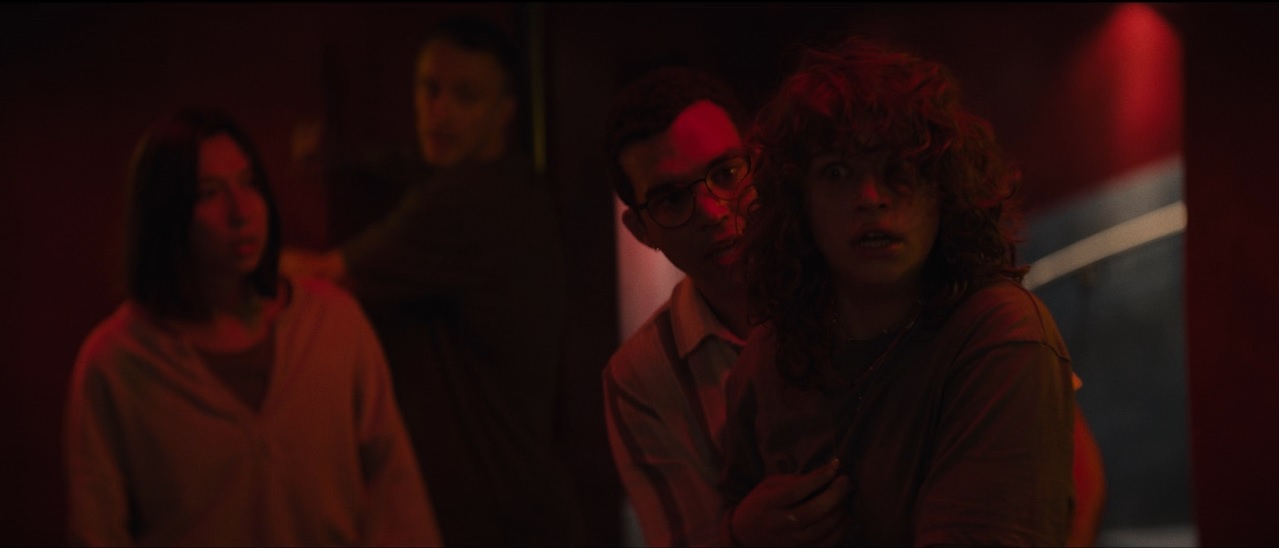
Riley (Odessa A'zion) and her friends are hunted by the Cenobites.

CHARACTERS:

Riley: The Riley we first meet is selfish, defensive, and more than a little belligerent - a fair characterization for an addict but not necessarily one that encourages viewers to want to spend time with her. We see enough of her daily life to know that she relies heavily on her brother. When the Cenobites begin stalking her and her friends, her first impulse is to say that Matt would know what to do (unlikely). She gradually emerges as a leader in her own right, keeping the group moving toward the relative safety of Voight's house and hatching a plan to try to save them, even as she still hopes to somehow get her brother back.

Colin: The boyfriend of Riley's brother, who is emotionally supportive to both of them. When Matt gets angry and kicks Riley out, Colin urges her to stay, insisting that this is just a bad night and that things will be better in the morning. Matt's disappearance has to be affecting him too, but he only truly lets that show in the immediate aftermath before setting his feelings aside to try to help Riley. True, his initial worries are more about her relapsing than about running into literal creatures from hell - but even when the demons appear, he manages to keep it together better than almost anyone would.

Trevor: Riley's new boyfriend, who kicks off this situation when he leads her to the puzzle box. After Matt disappears, he tries to take the box away from Riley, which she sees as a betrayal. When they come to find her in the second half, he and Colin fall to arguing almost immediately, leaving it to Riley to keep them both focused on the immediate problem.

Nora: Matt and Colin's roommate, Nora seems like an entirely decent person. She's not above teasing her friends, casually and visibly eavesdropping when Matt and Riley argue, but she's also ready to drop everything to help when needed. At Voight's house, when Trevor starts to pour a drink, she lightly reproves him for it: "We don't drink when Riley's around."

Matt: Riley's brother, whose disappearance motivates her actions for the rest of the movie. He behaves almost like her father, trying to set rules and boundaries that she inevitably kicks against. He kicks her out, only for the initial anger to fade, at which point his guilt leads him out to search for her. When he finds her in a stupor, he focuses on getting help for her, even when he cuts his hand - quite badly - on the puzzle box.

Voight: Goran Višnjić, as the occult-obsessed billionaire, grants considerable screen presence. His Voight conveys complete self-interest. "I get what I want!" he declares defiantly, treating dealings with demons as if he's in the midst of a real estate transaction. He cares nothing about others, and the movie opens with him tricking a young man (Kit Clarke) into solving the puzzle box so that he can sacrifice him for a wish. You don't have to have seen any of the other Hellraiser films to guess that Voight gets his wish, but not in the way that he'd have preferred.

Pinhead urges Riley to continue solving the puzzle.
"We want you to proceed." Pinhead urges Riley to continue solving the puzzle.

JAMIE CLAYTON AS PINHEAD:

"What is it you pray for? ...What would it feel like? A joyful note, without change, without end? Heaven? There's no music in that... There is so much more the body can be made to feel - and you'll feel it all before we're through."

This film bills Pinhead simply as "The Priest," because co-producer Clive Baker, author of the original novella and writer/director of the original film, hated the "Pinhead" nickname. Nice try, Mr. Barker, but I'm pretty sure everyone will continue referring to the character as Pinhead.

The book describes the Hell Priest as having no gender and a feminine voice, something Jamie Clayton conveys. The heavy costume severely restricted Clayton's movements. This has the same effect as it did on Doug Bradley's initial performance, with the stillness and rigid posture granting a formality to every step and gesture. Also like Bradley in the first film (far less so in the sequels), Pinhead doesn't threaten; she teases and promises, and you are best advised to avoid receiving any of her "gifts."

Though Clayton is more book accurate, I'm not remotely saying that she's better than Doug Bradley. Bradley's Pinhead is a horror icon. At his best, he was mesmerizing, alternating between anger and amusement, between impatience and weariness, often with just the tiniest shift of tone. Still, Clayton's a reasonably close second, and I would not in any way object to more films featuring this version of the character.

Riley stares at the puzzle box's newest configuration.

THOUGHTS:

David Bruckner's 2022 Hellraiser reboot is the first entry since Bloodline to have official involvement from Clive Barker. It's probably no coincidence that it's also the best film in the series since the first two, and probably the best since the 1987 original. 

That said, and as fond as I am of the early Hellraiser movies... This doesn't exactly clear a formidably high bar. The first movie remains excellent even decades later. Other entries are "flawed but ambitious," while the rest range from mediocre to downright awful.


WHAT DOESN'T WORK:

Hellraiser (2022) is a reboot, so it's fair enough that it changes some of the lore. A few of those changes are ones that I like... but I don't like Cenobites claiming innocent victims. "It is not hands that call us" is a lot more interesting - though, in fairness, after the first two films, the original series deviated from that principle more often than it stuck to it.

The movie's biggest problem is its length. The story here would make for a really good 100-minute horror flick. At 121 minutes, it feels overstretched. The plot doesn't properly kick into gear until Riley reaches Voight's estate, and that doesn't happen until the 50-minute mark. It gets rather good at that point and stays good through the end - but I did a fair amount of seat-shifting before then, with the first half hour coming distressingly close to boring me.

This would be fine if that time had been used to build memorable characters. Except for Riley, the members of the core group are as two-dimensional as the supporting casts of the direct-to-video entries. They never move beyond their initial descriptors: Brother, Boyfriend, Brother's Boyfriend, Roommate.

There's a memorable kill scene at the halfway mark in which one of the group is left to Pinhead's nonexistent mercy. Everything about the scene works: the victim's terror, Pinhead's speech, the ghastly cleverness to Pinhead's act and how that act ties in with her words. It's a great horror movie bit, disturbing and gripping all at the same moment - and if I had actually cared about the victim, it would have been truly unforgettable.

Voight's estate is a puzzle box in its own right.

WHAT WORKS, AND OFTEN QUITE WELL:

This film makes good use of the idea of the puzzle, something that was entirely lost in the earlier sequels. Each new configuration requires effort, and the progression from one shape to the next provides a goal beyond merely opening it. The individual bits of the box rotate, with shifting patterns according to those manipulations. Voight's mansion is a puzzle box in its own right, surrounded by metal gates and doors that open and close with the flip of switches. The landscape shifts in ways that resemble the shifts of the box, an ominous visual to herald the demons' arrival.

Riley is an addict, and her use of the box echoes facets of addiction. In narrative terms, the puzzle box is Riley's only hope of getting her brother back. It also works as a stand-in for her addiction. As Voight demonstrated, the box's promise is much like a drug's promise of satisfaction - a lie, a trick. There's no way to "win," and the Cenobites' gifts will not please those who receive them. But when the others try to get her to see this, she lashes out, even snapping at Trevor for betraying her when he tries to take it from her. Whether Matt even can get his resurrection or not is questionable. What's not in question is that Riley's fixation threatens to destroy not only her, but also the people who came to help her.

Though the first half is too slow, patient viewers will be rewarded with a strong second half. The barrier surrounding Voight's house allows the characters to get to something approximating safety, which allows them to think, react, and plan. But they are also under siege from that moment, with the Cenobites waiting outside: patient and unmoving as they await the blood that is their due. It's a situation well-suited to building tension.

I also quite like the ending. I won't discuss it, because I don't want to risk spoiling it for anyone who hasn't seen the movie. But it's an excellent finale in terms of both story and theme, and I found it vastly more satisfying than a "Final Girl" manipulating the box and shouting, "Go to hell!" at Pinhead.
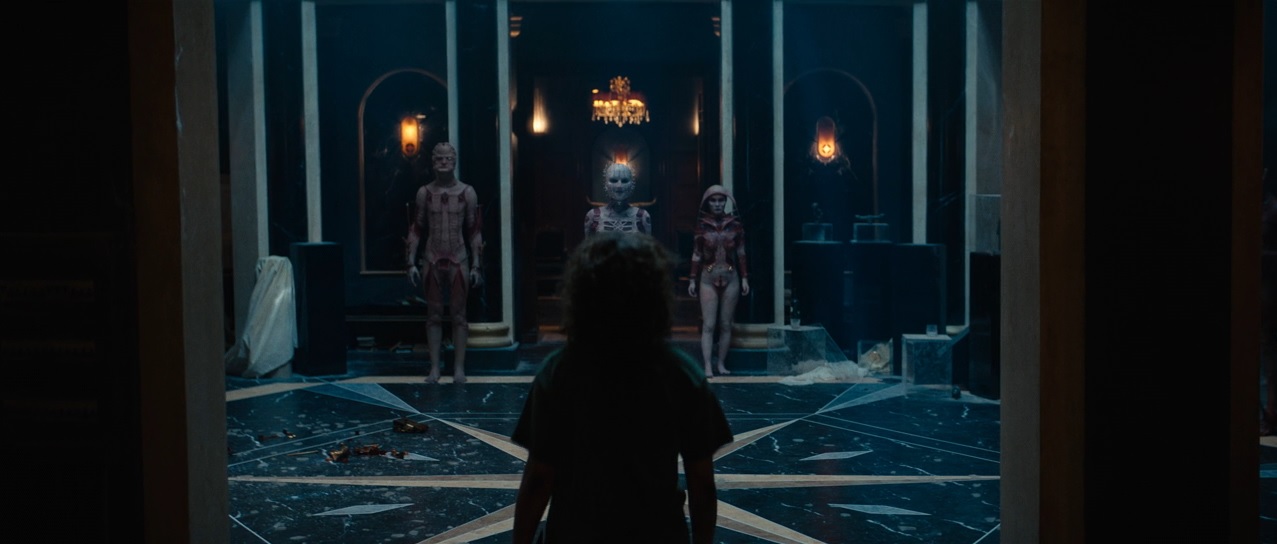
Riley confronts the Cenobites.

OVERALL:

Hellraiser (2022) is a good movie on its own terms, and it's exactly the resurrection that this series needed after years in the low budget direct-to-video graveyard. It has its issues, notably a painfully slow start and a bland supporting cast. It's clear watching it, however, that thought and effort went into its making.

There's room for improvement. But for the first time in a long time, I find myself hoping that there will be another Hellraiser. If another movie refined and built on the elements that worked, and rejected the ones that didn't, I think the result might be something special.


Overall Rating: 7/10.

Previous Movie: Hellraiser - Judgment

Review Index

To receive new review updates, follow me:

On BlueSky:

On Threads:

Friday, October 13, 2023

2. Hellbound: Hellraiser II.

Julia (Clare Higgins) tempts the occult-obsessed Dr. Channard (Kenneth Cranham).
Julia (Clare Higgins) tempts the occult-
obsessed Dr. Channard (Kenneth Cranham).

Release Date: Sept. 9, 1988. Running Time: 93 minutes (theatrical), 99 minutes (unrated). Screenplay by: Peter Atkins. Based on the novella, The Hellbound Heart, by Clive Barker. Directed by: Tony Randel. Produced by: Christopher Figg, David Barron.


THE PLOT:

After the bloodbath at her father's house, Kirsty (Ashley Laurence) is taken to the Channard Institute, a psychiatric hospital. She pleads with the investigating detective to burn the mattress where her stepmother, Julia (Clare Higgins), had died. Kirsty insists that the mattress could allow Julia to return the same way her evil uncle Frank did, but her talk of hell and demons is dismissed as ravings and hallucinations.

But she's not dismissed by Dr. Channard (Kenneth Cranham). He has harbored a lifelong fascination with the occult, including the Lament Configuration. He uses his connections to secure both the mattress and the puzzle box. With a hospital full of patients at his disposal, it isn't long before he has brought Julia back from the dead.

One of the patients at the Institute is Tiffany (Imogen Boorman), a young girl who spends all her time compulsively solving puzzles. Channard uses her to open the Lament Configuration. Then, with Julia as his guide, he walks straight into hell, determined to unlock its secrets.

Kirsty follows, on a mission of her own: to find and rescue her murdered father!

Tiffany (Imogen Boorman) solves the puzzle box - and opens the door to hell!
Tiffany (Imogen Boorman) solves the puzzle
box - and opens the door to hell!

CHARACTERS:

Julia: Ironically, she seems almost more human than at the end of the first film. Not in any positive way, mind you, but because she seems consumed by her old resentments. She toys sadistically with Kirsty, who never even gave her a chance to be anything other than the "wicked stepmother." She seizes that title along with "evil queen" for herself, and her interactions with Kirsty - half teasing, half vicious - are similar to the Cenobites... only unlike them, her cruelty is deliberate. Actress Clare Higgins is once again the film's greatest asset, and I don't think the series' quality ever recovered from her decision to make this her final entry.

Kirsty: I don't think Kirsty particularly works as a character in this movie. She has no self-preservation instincts, telling anyone who will listen about the demons she saw even when this (predictably) gets her taken to a mental hospital. Her bond with Tiffany might have provided an emotional throughline... except that this receives little screen time, being more assumed by the script than demonstrated. I will say that a scene in the second half that sees Kirsty coming face-to-face with her vile uncle Frank features some excellent acting from Ashley Laurence. Unfortunately, outside of this moment, Kirsty never feels particularly connected to the rest of the movie, which is more centered around Channard and Tiffany than around her.

Dr. Channard: There are two versions of Channard: the fully human one of the first half and a version that's been transformed within the labyrinth. It's the human Channard who is the scarier: Clinical to the point of being emotionless, but also consumed with an occult obsession that leads him to horrific acts, committed solely to satisfy his hunger "to know." He uses one delusional patient as a sacrifice, letting the man's blood draw Julia back to life. He sacrifices more patients to allow her to recover the thin veneer of humanity that is her skin. Finally, he offers up Tiffany as a sacrifice to the Cenobites, counting on her both to solve the box and to appease the demons - though this doesn't quite go according to plan.

Frank: My pick for the movie's best scene is the one in which Kirsty finds Frank in his own personal hell. Sean Chapman has thankfully been allowed to deliver his own lines rather than being overdubbed, and as a result Frank feels more fully realized. He's vicious, and the fate he has in mind for Kirsty would make the Cenobites' attentions seem almost appealing by comparison, but Chapman brings in other notes: frustration, anger, a sense of misplaced victimhood, and ridiculous overconfidence. It's this last that is his undoing, as Frank never considers that the power dynamics have shifted in his absence.

Tiffany: One of Dr. Channard's patients, young Tiffany spends all her time completing puzzles. Channard's assistant, Kyle (William Hope) muses that the puzzles may be her way of trying to resolve some trauma. In reality, Channard's obsession is the source of her trauma, which is divulged via flashbacks/visions once she passes through to the labyrinth.

Pinhead: After a recap, the new material begins with his origin story, as a World War I officer who sought out and opened the box for reasons that would be divulged in the third movie. His military background may explain the reserve and control that the other Cenobites lack. The female Cenobite is all set to descend on Tiffany, but Pinhead refuses because that would violate the rules. "It is not hands that call us. It is desire!" He also doesn't lie (no, not even in the first film - His deal with Kirsty was a very provisional "maybe"). When Kirsty refuses to believe that her father is unreachable, he allows her to "explore," to find out the truth for herself - probably in part to increase her despair when she fails to find him.

The Labyrinth, with the dark god Leviathan at its center.

BUILDING THE MYTHOLOGY:

Hellbound: Hellraiser II is regularly regarded as the best of the Hellraiser sequels. The acting ranges from acceptable to very good. There's a unified visual style which complements the original film while also pushing the tone from horror into the realm of dark fantasy. The scenes in the labyrinth greatly build the series' mythology, establishing much of the hierarchy of this hell - from Leviathan, the dark god of the Labyrinth, to the creation of the Cenobites from human beings.

The movie introduces a psychological element to the torments endured by the box's victims. In the first film, we saw Frank savaged with chains... and then (in best Galaxy Quest voice) exploded. In this movie, physical pain is largely reserved for the real world, through the acts perpetrated by Channard and Julia before the box is opened. In the labyrinth, victims are punished in ways that strike at an emotional level.

Immediately before Kirsty's first encounter with the Cenobites, the Labyrinth delivers its first torture: Her old bedroom, a representation of the happy life she had with her parents. She smiles at her mother's picture... only to watch in horror, first as blood seeps from her old trappings, and then as her mother's beloved visage is replaced by Julia's hated one. When she finds Frank, he's suffering his own torment: Not chains or fire, but beautiful women on beds, whose forms vanish the instant he approaches, constantly inflaming his desires but never satisfying them.

Kirsty enters a nightmare version of her father's house, one of the few scenes in which she's an actual character.
Kirsty enters a nightmare version of her father's house,
one of the few scenes in which she's an actual character.

THE TROUBLE WITH KIRSTY:

The movie's first half is excellent. It builds steadily, first to Julia's return and then to the opening of the box. Up to this point, the threads work together. Kirsty's story alerts Channard that the focus of his obsession is in reach. Channard uses his connections to secure the mattress, then uses his patients to bring back and restore Julia. He also uses Tiffany to open the box, and with it the gates to hell. Then Julia, Channard, Tiffany, and Kirsty all pass through those doors, each in pursuit of a different goal. All of this feels unified; each character is searching for something, and their actions directly impact the other threads.

That unity fractures the instant the action shifts to the labyrinth. Some good set pieces disguise the problem for a while: Kirsty's old room, her encounter with the Cenobites, the scene with Frank. Gradually, however, it becomes clear that all of these scenes are about tying up the loose ends of the first film. Kirsty isn't really a part of the sequel's story at all.

There are two problems at play. The first, smaller issue was caused by the loss of actor Andrew Robinson, who had played her father in the first film. I've read differing reasons for why he rejected the role: dislike of the script, a role that was little more than a cameo, a lowball financial offer. It could well have been all three! In any event, the refusal appears to have come too late for the Page One rewrite that was needed to compensate. As a result, Kirsty's story feels incomplete, her quest not so much ending as being abandoned.

Even had Robinson come back, it would not have helped the larger problem: Kirsty's goals and emotional journey have no connection with this movie's own story. The final Act leaves her with no goal of her own. She's just left to act as Tiffany's protector; even at the climax, the real focus is not on her but instead on Channard and Tiffany.

As writer Pete Atkins has noted, Larry Cotton was a decent man, and there's no reason to believe he's in any form of hell. Perhaps it would have worked better had Kirsty been focused Julia - first the fear of her return, and then determination to destroy the woman who destroyed her family. That might have tied her more completely to the sequel's story, with Julia becoming her "white whale," a focus for her anger (which might, in turn, have given her a genuine dark impulse to draw the Cenobites to her).

As it stands, there's one thread too many in this film - and that redundant thread is Kirsty's. Since she's been presented as the movie's moral and emotional center, her near-irrelevance in the final stretch throws the narrative badly off-kilter near the end.

Pinhead's entrance - which occurs about halfway through.

VERSIONS:

Hellbound: Hellraiser II is much more violent than its predecessor, and severe cuts were made to secure an "R" rating. The sequence in which Channard uses a patient to resurrect Julia is actively unpleasant to watch, and it's unsurprising that it was gutted to just a few shots in the theatrical version. Other minor bits of gore were snipped, along with - bizarrely - the moody little moment in which Kirsty finds herself in her old bedroom.

The theatrical version is all but inaccessible today, with the 99-minute Unrated cut being the primary one released both on disc and on streaming services. This is a good thing, as the cuts were too severe for coherence in some cases - though I'll admit that the scene with Channard's patient is one that I tend to look away from even on rewatch.


OVERALL:

There is a lot that's good in Hellbound: Hellraiser II. Both the script and visuals build on the world of the first film. The mythology is expanded, and the idea is introduced of tortures that are more psychological than physical. I love that almost all of the actual "horror movie" violence occurs in the real world, while the fantasy world instead explores its victims' psychologies.

The first half is excellent. Unfortunately, the strain starts to show around the midpoint. I know other opinions are available; but to me, the lack of emotional connection between Kirsty's thread and the main plot cripples the final Act, leaving the last twenty minutes feeling empty and a bit chaotic.

I rated this a “6” on first posting - but with a bit of distance and particularly in comparison with the later films, I think that was too low. The last Act really doesn’t work for me… but the movie had me until the last twenty minutes, so I’m bumping that up a point.


Overall Rating: 7/10.

Previous Movie: Hellraiser (1987)
Next Movie: Hellraiser III - Hell on Earth

Review Index

To receive new review updates, follow me:

On BlueSky:

On Threads: