Showing posts with label Sean Chapman. Show all posts

Friday, October 13, 2023

2. Hellbound: Hellraiser II.

Julia (Clare Higgins) tempts the occult-obsessed Dr. Channard (Kenneth Cranham).
Julia (Clare Higgins) tempts the occult-
obsessed Dr. Channard (Kenneth Cranham).

Release Date: Sept. 9, 1988. Running Time: 93 minutes (theatrical), 99 minutes (unrated). Screenplay by: Peter Atkins. Based on the novella, The Hellbound Heart, by Clive Barker. Directed by: Tony Randel. Produced by: Christopher Figg, David Barron.


THE PLOT:

After the bloodbath at her father's house, Kirsty (Ashley Laurence) is taken to the Channard Institute, a psychiatric hospital. She pleads with the investigating detective to burn the mattress where her stepmother, Julia (Clare Higgins), had died. Kirsty insists that the mattress could allow Julia to return the same way her evil uncle Frank did, but her talk of hell and demons is dismissed as ravings and hallucinations.

But she's not dismissed by Dr. Channard (Kenneth Cranham). He has harbored a lifelong fascination with the occult, including the Lament Configuration. He uses his connections to secure both the mattress and the puzzle box. With a hospital full of patients at his disposal, it isn't long before he has brought Julia back from the dead.

One of the patients at the Institute is Tiffany (Imogen Boorman), a young girl who spends all her time compulsively solving puzzles. Channard uses her to open the Lament Configuration. Then, with Julia as his guide, he walks straight into hell, determined to unlock its secrets.

Kirsty follows, on a mission of her own: to find and rescue her murdered father!

Tiffany (Imogen Boorman) solves the puzzle box - and opens the door to hell!
Tiffany (Imogen Boorman) solves the puzzle
box - and opens the door to hell!

CHARACTERS:

Julia: Ironically, she seems almost more human than at the end of the first film. Not in any positive way, mind you, but because she seems consumed by her old resentments. She toys sadistically with Kirsty, who never even gave her a chance to be anything other than the "wicked stepmother." She seizes that title along with "evil queen" for herself, and her interactions with Kirsty - half teasing, half vicious - are similar to the Cenobites... only unlike them, her cruelty is deliberate. Actress Clare Higgins is once again the film's greatest asset, and I don't think the series' quality ever recovered from her decision to make this her final entry.

Kirsty: I don't think Kirsty particularly works as a character in this movie. She has no self-preservation instincts, telling anyone who will listen about the demons she saw even when this (predictably) gets her taken to a mental hospital. Her bond with Tiffany might have provided an emotional throughline... except that this receives little screen time, being more assumed by the script than demonstrated. I will say that a scene in the second half that sees Kirsty coming face-to-face with her vile uncle Frank features some excellent acting from Ashley Laurence. Unfortunately, outside of this moment, Kirsty never feels particularly connected to the rest of the movie, which is more centered around Channard and Tiffany than around her.

Dr. Channard: There are two versions of Channard: the fully human one of the first half and a version that's been transformed within the labyrinth. It's the human Channard who is the scarier: Clinical to the point of being emotionless, but also consumed with an occult obsession that leads him to horrific acts, committed solely to satisfy his hunger "to know." He uses one delusional patient as a sacrifice, letting the man's blood draw Julia back to life. He sacrifices more patients to allow her to recover the thin veneer of humanity that is her skin. Finally, he offers up Tiffany as a sacrifice to the Cenobites, counting on her both to solve the box and to appease the demons - though this doesn't quite go according to plan.

Frank: My pick for the movie's best scene is the one in which Kirsty finds Frank in his own personal hell. Sean Chapman has thankfully been allowed to deliver his own lines rather than being overdubbed, and as a result Frank feels more fully realized. He's vicious, and the fate he has in mind for Kirsty would make the Cenobites' attentions seem almost appealing by comparison, but Chapman brings in other notes: frustration, anger, a sense of misplaced victimhood, and ridiculous overconfidence. It's this last that is his undoing, as Frank never considers that the power dynamics have shifted in his absence.

Tiffany: One of Dr. Channard's patients, young Tiffany spends all her time completing puzzles. Channard's assistant, Kyle (William Hope) muses that the puzzles may be her way of trying to resolve some trauma. In reality, Channard's obsession is the source of her trauma, which is divulged via flashbacks/visions once she passes through to the labyrinth.

Pinhead: After a recap, the new material begins with his origin story, as a World War I officer who sought out and opened the box for reasons that would be divulged in the third movie. His military background may explain the reserve and control that the other Cenobites lack. The female Cenobite is all set to descend on Tiffany, but Pinhead refuses because that would violate the rules. "It is not hands that call us. It is desire!" He also doesn't lie (no, not even in the first film - His deal with Kirsty was a very provisional "maybe"). When Kirsty refuses to believe that her father is unreachable, he allows her to "explore," to find out the truth for herself - probably in part to increase her despair when she fails to find him.

The Labyrinth, with the dark god Leviathan at its center.

BUILDING THE MYTHOLOGY:

Hellbound: Hellraiser II is regularly regarded as the best of the Hellraiser sequels. The acting ranges from acceptable to very good. There's a unified visual style which complements the original film while also pushing the tone from horror into the realm of dark fantasy. The scenes in the labyrinth greatly build the series' mythology, establishing much of the hierarchy of this hell - from Leviathan, the dark god of the Labyrinth, to the creation of the Cenobites from human beings.

The movie introduces a psychological element to the torments endured by the box's victims. In the first film, we saw Frank savaged with chains... and then (in best Galaxy Quest voice) exploded. In this movie, physical pain is largely reserved for the real world, through the acts perpetrated by Channard and Julia before the box is opened. In the labyrinth, victims are punished in ways that strike at an emotional level.

Immediately before Kirsty's first encounter with the Cenobites, the Labyrinth delivers its first torture: Her old bedroom, a representation of the happy life she had with her parents. She smiles at her mother's picture... only to watch in horror, first as blood seeps from her old trappings, and then as her mother's beloved visage is replaced by Julia's hated one. When she finds Frank, he's suffering his own torment: Not chains or fire, but beautiful women on beds, whose forms vanish the instant he approaches, constantly inflaming his desires but never satisfying them.

Kirsty enters a nightmare version of her father's house, one of the few scenes in which she's an actual character.
Kirsty enters a nightmare version of her father's house,
one of the few scenes in which she's an actual character.

THE TROUBLE WITH KIRSTY:

The movie's first half is excellent. It builds steadily, first to Julia's return and then to the opening of the box. Up to this point, the threads work together. Kirsty's story alerts Channard that the focus of his obsession is in reach. Channard uses his connections to secure the mattress, then uses his patients to bring back and restore Julia. He also uses Tiffany to open the box, and with it the gates to hell. Then Julia, Channard, Tiffany, and Kirsty all pass through those doors, each in pursuit of a different goal. All of this feels unified; each character is searching for something, and their actions directly impact the other threads.

That unity fractures the instant the action shifts to the labyrinth. Some good set pieces disguise the problem for a while: Kirsty's old room, her encounter with the Cenobites, the scene with Frank. Gradually, however, it becomes clear that all of these scenes are about tying up the loose ends of the first film. Kirsty isn't really a part of the sequel's story at all.

There are two problems at play. The first, smaller issue was caused by the loss of actor Andrew Robinson, who had played her father in the first film. I've read differing reasons for why he rejected the role: dislike of the script, a role that was little more than a cameo, a lowball financial offer. It could well have been all three! In any event, the refusal appears to have come too late for the Page One rewrite that was needed to compensate. As a result, Kirsty's story feels incomplete, her quest not so much ending as being abandoned.

Even had Robinson come back, it would not have helped the larger problem: Kirsty's goals and emotional journey have no connection with this movie's own story. The final Act leaves her with no goal of her own. She's just left to act as Tiffany's protector; even at the climax, the real focus is not on her but instead on Channard and Tiffany.

As writer Pete Atkins has noted, Larry Cotton was a decent man, and there's no reason to believe he's in any form of hell. Perhaps it would have worked better had Kirsty been focused Julia - first the fear of her return, and then determination to destroy the woman who destroyed her family. That might have tied her more completely to the sequel's story, with Julia becoming her "white whale," a focus for her anger (which might, in turn, have given her a genuine dark impulse to draw the Cenobites to her).

As it stands, there's one thread too many in this film - and that redundant thread is Kirsty's. Since she's been presented as the movie's moral and emotional center, her near-irrelevance in the final stretch throws the narrative badly off-kilter near the end.

Pinhead's entrance - which occurs about halfway through.

VERSIONS:

Hellbound: Hellraiser II is much more violent than its predecessor, and severe cuts were made to secure an "R" rating. The sequence in which Channard uses a patient to resurrect Julia is actively unpleasant to watch, and it's unsurprising that it was gutted to just a few shots in the theatrical version. Other minor bits of gore were snipped, along with - bizarrely - the moody little moment in which Kirsty finds herself in her old bedroom.

The theatrical version is all but inaccessible today, with the 99-minute Unrated cut being the primary one released both on disc and on streaming services. This is a good thing, as the cuts were too severe for coherence in some cases - though I'll admit that the scene with Channard's patient is one that I tend to look away from even on rewatch.


OVERALL:

There is a lot that's good in Hellbound: Hellraiser II. Both the script and visuals build on the world of the first film. The mythology is expanded, and the idea is introduced of tortures that are more psychological than physical. I love that almost all of the actual "horror movie" violence occurs in the real world, while the fantasy world instead explores its victims' psychologies.

The first half is excellent. Unfortunately, the strain starts to show around the midpoint. I know other opinions are available; but to me, the lack of emotional connection between Kirsty's thread and the main plot cripples the final Act, leaving the last twenty minutes feeling empty and a bit chaotic.

I rated this a “6” on first posting - but with a bit of distance and particularly in comparison with the later films, I think that was too low. The last Act really doesn’t work for me… but the movie had me until the last twenty minutes, so I’m bumping that up a point.

Thursday, October 5, 2023

1. Hellraiser (1987).

Kirsty's Uncle Frank is back from the dead. This is not good news.
Uncle Frank is back from the dead. This is not good news.

Release Date: Sept. 10, 1987. Running Time: 93 minutes. Screenplay by: Clive Barker. Based on the novella, The Hellbound Heart, by Clive Barker. Directed by: Clive Barker. Produced by: Christopher Figg.


THE PLOT:

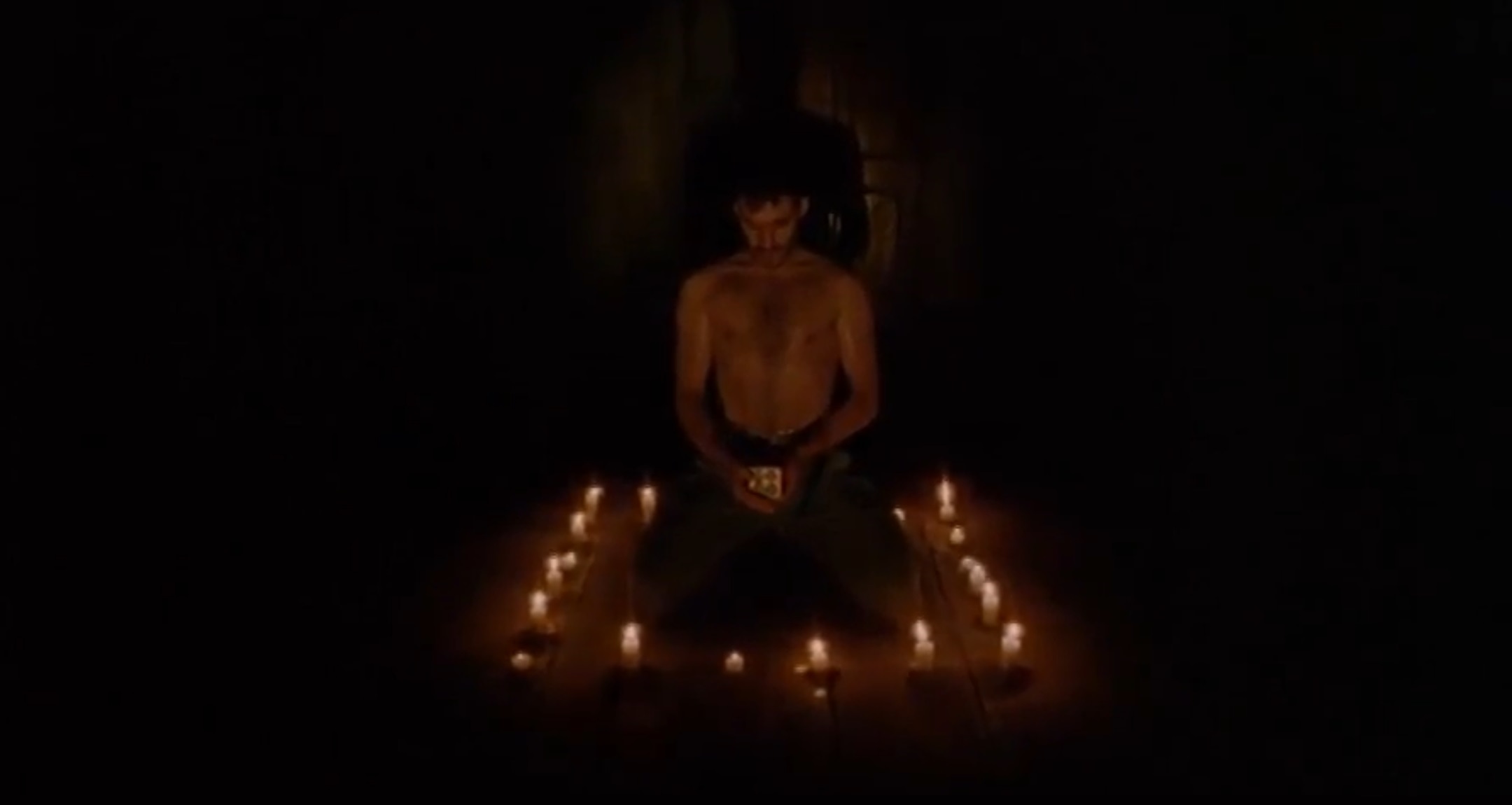
Larry (Andrew Robinson) and his second wife, Julia (Clare Higgins), have just moved into a house that is absolutely in America and is certainly, definitely not in north London. The house belonged to Larry's mother; but when they arrive, they can see that his no-good brother, Frank (Sean Chapman), had been squatting there, though he seems to be gone now.

Years earlier, Julia had an affair with Frank. She was drawn by his disregard for social niceties, such as not sleeping with your brother's wife, and by his insistence on pushing the limits of pleasure. That last was the trait that got Frank in trouble, after he procured a mystical puzzle box which opened a gateway to a very literal hell.

While moving their things into the house, Larry slices his hand open on an exposed nail. The blood from the wound drips into the floorboards of the very room where Frank solved the puzzle box. Somehow, those drops of his brother's blood are enough to revive Frank!

Julia discovers the husk of her lover, and Frank begs for her to get more blood to restore him. Soon, she is drawing men to the house, killing them so that he can become whole. But Frank knows that his escape will not go unnoticed for long. He needs more blood before his demonic jailers, the Cenobites, come looking for him - and his sights are set on Larry!

The unhappy couple: Larry Cotton (Andrew Robinson) and his second wife, Julia (Clare Higgins).
The unhappy couple: Larry Cotton (Andrew Robinson)
and his second wife, Julia (Clare Higgins).

CHARACTERS:

Larry: Andrew Robinson was the movie's "name actor," a familiar face from both big screen and small whose presence would reassure audiences that this was a real movie. Behind-the-scenes material makes clear that Larry is meant to be someone defeated by life, a man who's given up in the face of disappointments. Unfortunately, little of this comes across. For the first hour, Larry's just sort of... there. Thankfully, the last part of the film allows Robinson some memorable moments, and he rises to that with manic energy - and, per the behind-the-scenes material, a few well-judged ad-libs. It's just too bad that, for most of the running time, poor Larry is more of a plot device than an actual character.

Julia: Frank talks about going "to the limits," but it's Julia who actually pushes what she had considered her limits. The Julia we first meet would almost certainly never consider murder, and she seems to come close to letting her first victim leave unharmed. Then the man turns aggressive, and you can practically see the moment Julia decide that she will go through with it after all. She's horrified by that first kill... but as she lets herself absorb what she's done, her expression changes, and we sense that a part of her enjoyed it. She sets new limits, lines that she insists she won't cross. In every case, she ends up going past that point, until by the end she's as much a monster as Frank is.

Kirsty: Larry's daughter from his first marriage, Kirsty (Ashley Laurence) resents Julia. There's no indication that she suspects her stepmother of anything nefarious. It's just the usual resentment of a young girl at seeing her mother replaced. She's mainly on the periphery for the first half, but she takes center stage in the final half hour. While the first hour is mostly presented through Julia's perspective, the final Act shifts to Kirsty, with her filling the '80s horror heroine/"final girl" role of being menaced by monsters, both human and otherwise.

Frank: Larry's hedonist brother, whose purchase of the puzzle box kicks off the story. Larry speaks of him with scorn, while Julia regards him with fascination. Though Sean Chapman, who plays the human Frank in flashbacks, has relatively little screen time, he makes a strong impression. He carries himself with the confidence of a man who takes what he wants with no heed for morality or consequences, and he and Clare Higgins have convincing screen chemistry that helps sell Julia's obsession. The present Frank - the monster - is played by Oliver Smith, with both actors overdubbed in the final product.

Pinhead (Doug Bradley) menaces Kirsty (Ashley Laurence).

DOUG BRADLEY AS PINHEAD... ER, "LEAD CENOBITE"

"We have such sights to show you..."
-Pinhead doesn't so much threaten as promise Kirsty an eternity of torment.

Doug Bradley's Pinhead is the monster of the Hellraiser series, with his visage gracing every poster and video cover. He was not originally envisioned as the primary monster, though. In this first film, he doesn't even have a name, being billed merely as "Lead Cenobite."

It's easy to see why he captured horror fans' attention. Bradley commands the screen. His deep voice, which seems to come up from some inner well, is far from book accurate; the "Hell Priest" in The Hellbound Heart was described as androgynous in both form and voice. But the voice perfectly fits both the film character and the splendid makeup job. Then there are Bradley's movements. The costume left him restricted in movement, which ends up being a benefit to the final product. When he moves, it's slowly. When he gestures, it's with deliberate care. Combined with the voice, this creates a sense of formality which only accentuates his power.

The character was referred to as the "Hell Priest" in both the novella and in the 2022 film, and some of his manner fits with that. Kirsty is able to save herself from the Cenobites by trading her freedom for Frank, the man who escaped them. When the female cenobite (Grace Kirby) indicates that she would prefer Kirsty, Pinhead shuts her down, phrasing it in quasi-religious terms as he insists on recovering Frank: "I want to hear him confess himself!"

All of this works together to make for a horror movie creation that, in his first appearance, earns his iconic status. Bradley, the costume and makeup design, and the writing all come together to create a figure that, in a mere eight minutes of screen time, ends up being the most memorable feature of a rather good movie.

Frank (Sean Chapman)'s first meeting with Julia... but the dubbing makes his dialogue seem artificial.
Frank (Sean Chapman)'s first meeting with Julia...
but the dubbing makes his dialogue seem artificial.

THE SEMI-AMERICANIZATION:

A late production decision was taken by New World Pictures to redub several actors to "Americanize" it. This works well enough for Frank in his monster form, but it damages the flashbacks to human Frank and his affair with Julia. There's something aurally artificial about human Frank's lines. The words match the lip movements, but there's a processed quality that just sounds "off."

In the case of Kirsty's boyfriend, Steve (Robert Hines), there actually are a few lines that don't match lip movements. The dubbing also makes a hash of one exchange between Kirsty and Steve. She compares him to Julia, talking about how they're "uptight and frigid." Steve protests, "We're not all frigid," before pulling her in for an embrace. In its original context, an American girl would have been semi-jokingly comparing her British boyfriend to her British stepmother. With Steve Americanized, however, I have no idea who Steve's "we all" could reference. People with very '80s hair, I suppose - though that would include Kirsty as well.

I will allow that the redubbing contributes slightly to the atmosphere. Some of the settings are very British looking, while the mix of British and American accents clashes a bit with that. This oddly accents the sense of something otherworldly even before the demons show up.

Each of Julia's kills make Frank more human - and Julia less human...
Each of Julia's kills make Frank more
human - and Julia less human...

OTHER MUSINGS:

After being disappointed with two low-budget adaptations of a pair of his short stories (Rawhead Rex and Transmutations/Underworld), horror author Clive Barker was determined to direct his own work. Hellraiser became his first film as director. Despite its success, Barker would direct only two more feature films: Nightbreed and Lord of Illusions. I think this is a pity. All three movies have their faults, but all three also show a strong visual style and an ability to maintain atmosphere.

The movie's polish is boosted enormously by Christopher Young's score. The orchestral score emphasizes the sense of the otherworldly, making itself almost a musical counterpart to Pinhead's promise: "I have such sights to show you." As Frank is brought to life by Larry's blood, visualized through some creative and eye-catching visual effects, there's something triumphant about this resurrection. We don't yet know the details of what has happened to him, but we are musically thrust into his point of view as he exults in rebirth and his (as yet unknown to us) escape from his infernal prison.

The story itself is structured around points of view, the script shifting from one character to the next. A brief prologue with Frank kicks off the story and gives the audience an opening jolt. Then the film shifts primarily to Julia's viewpoint. There are a few cutaways to Kirsty, putting her into position to take over in the final Act, but until about the fifty-minute mark the story stays mainly with Julia. Then we cut to Kirsty's viewpoint with the climax, staying with her almost to the end, save for a closing sting.

The shifts help to keep the pace moving, but there is an inescapable problem when the focus shifts from Julia to Kirsty: Julia is a vastly more interesting character. For more than half the running time, we follow her as she descends from a merely unhappy wife into a mass murderer. She is horrified by Frank's monstrous appearance, but she doesn't remain horrified for long. She resists the idea of committing murder... but then she does it, and she even finds that a part of her enjoys the experience. Julia keeps drawing lines - but in every case, she ends up crossing those lines. Even at the end, we don't know where her final stopping point would be, or if she even has one.

By contrast, Kirsty is mostly a stock horror movie heroine. Ashley Laurence gives her a certain fierce physicality, particularly when she struggles bodily with Frank, and her overall performance is well above average for a low budget '80s horror flick. Even so, there's little depth to the character as written. Fortunately, the shift to her viewpoint coincides with the proper introduction of the Cenobites, and it's mainly down to them to keep up interest in the final stretch.

Frank opens the box, kick-starting the plot.

OVERALL:

The 1980s were the decade for horror classics: The Evil Dead, Re-Animator, John Carpenter's The Thing and Prince of Darkness, the Friday the 13th and Nightmare on Elm Street franchises, the Halloween sequels. Some of these were lousy, of course. But others were great, and it was a decade that offered an all-you-can-eat buffet of the macabre, with little sense that studios were afraid of pushing the boundaries of the "R" rating.

Hellraiser was among the last '80s horror franchises. Though the sequels would be variable in quality, the original still holds up within its genre. It succeeds as much through restraint as gore. After the prologue, the major moments of violence are held off, allowing for a slow build to the action. Performances are good, with Clare Higgins particularly strong.

Add in a well-structured screenplay and some creative special effects, and I'd have to say this movie is a fair bit better than I had expected. It's very much a product of its time, but it's still genuinely absorbing and unsettling. It may not transcend its genre - but it remains a highly effective example of that genre.


Overall Rating: 9/10.

Next Movie: Hellbound - Hellraiser II

Review Index

To receive new review updates, follow me:

On Twitter:

On Threads: